Data Privacy Regulations 2026: Compliance Checklist
Hey there, business owner, marketer, or tech professional — if you’re handling any kind of customer data in 2026, you already feel the pressure. Data privacy regulations aren’t just legal checkboxes anymore. They’re the foundation of trust with your customers, the shield against hefty fines, and a smart way to stand out in a crowded market.
This year brings a bigger, more connected web of rules than ever before. From California’s updated CCPA requirements and 20 U.S. states with their own comprehensive laws, to the EU’s ongoing GDPR enforcement mixed with AI Act timelines, and India’s DPDP Act rolling out in phases — staying compliant feels like navigating a maze. But here’s the good news: you don’t need a law degree or a massive legal team to get it right.
You’ll get a clear understanding of the major data privacy regulations active right now in 2026, plus a complete compliance checklist you can start using today. Whether you’re a small e-commerce shop in Jamshedpur, a growing SaaS company, or a multinational with customers worldwide, this post is built for you.
We’ll cover explanations, common mistakes to dodge, and free or low-cost tools that actually work. By the end, you’ll have a ready-to-implement action plan.
Ready? Let’s start.

Image credit: WFA Global Privacy Map – showing the worldwide spread of data privacy regulations in 2026
Why Data Privacy Regulations Matter More Than Ever in 2026
Think about the last time you bought something online or signed up for an app. Did you check the privacy policy? Most people don’t — but they expect their data to be safe. In 2026, customers are smarter and quicker to switch if they feel their information isn’t protected.
Data privacy regulations exist to give people control over their personal information — names, emails, locations, health details, browsing habits, and more. For businesses, non-compliance can mean fines that reach millions (or even billions in extreme cases), lawsuits, damaged reputation, and lost sales.
This year is special because enforcement is ramping up everywhere. Regulators have had years to learn from past mistakes, and they’re now issuing bigger penalties faster. At the same time, new technologies like AI make data collection easier — and riskier.
Small businesses often think “this doesn’t apply to me.” Wrong. Many data privacy regulations have extraterritorial reach. If you have even one customer in California or the EU, parts of these rules likely apply. The good news? Following good privacy practices builds loyalty. Customers who trust you spend more and stay longer.
In our earlier guide on building customer trust online, we showed how transparent data handling can boost conversion rates by up to 25%. Privacy isn’t a cost — it’s a competitive advantage.
Image credit: GDPR compliance shield concept – a common visual for strong data protection frameworks
Understanding the Global Landscape of Data Privacy Regulations
Data privacy regulations aren’t one single law. They’re a patchwork that changes by country and even by state. In 2026, the world has more than 150 privacy-related laws, but a few big ones dominate for most businesses.
The core idea across almost all of them is the same:
- Collect only what you need
- Get proper permission
- Keep data safe
- Let people control their own information
- Be transparent and accountable
Yet the details differ. The EU focuses heavily on individual rights. The U.S. uses a state-by-state approach with strong consumer opt-out rights. India emphasizes consent and local oversight. This creates challenges for companies operating across borders, but also opportunities to adopt best practices that satisfy multiple rules at once.
A quick tip: Start with the strictest rules that apply to you (usually GDPR or CCPA), and you’ll often meet most others automatically. We’ll show you exactly how in the checklist section.

Image credit: World map showing expanding data protection laws globally – perfect overview for 2026 compliance planning
Key Data Privacy Regulations You Need to Know in 2026
GDPR and EU Updates
The General Data Protection Regulation (GDPR) remains the gold standard seven years after it launched. In 2026, it’s not being replaced, but enforcement is getting smarter and faster thanks to new coordination rules across EU countries.
Key requirements that still apply:
- Lawful basis for every piece of data you process
- Clear, easy-to-understand privacy notices
- Strong rights for individuals (access, deletion, portability, objection)
- Data Protection Officer (DPO) for larger organizations
- Strict breach notification within 72 hours
What’s new or emphasized in 2026:
- Closer alignment with the EU AI Act (high-risk AI systems need extra transparency and risk assessments)
- Simplified rules for small businesses on record-keeping in some proposals
- Focus on international data transfers — make sure your contracts and safeguards are up to date
If you serve EU customers, even from India, GDPR likely applies. Fines can reach 4% of global annual turnover. For more depth, check our detailed GDPR compliance guide for non-EU businesses.
External resource: Official EDPB guidelines – https://www.edpb.europa.eu/
U.S. State Laws Including CCPA 2026 Updates
The United States doesn’t have a single federal privacy law yet, but 2026 marks a big milestone: 20 states now enforce comprehensive data privacy regulations.
California leads the pack. The California Consumer Privacy Act (CCPA), strengthened by CPRA, received major regulation updates effective January 1, 2026. These include:
- Mandatory risk assessments for high-risk processing
- Cybersecurity audit requirements for larger businesses
- New rules around Automated Decision-Making Technology (ADMT) — think algorithms that decide on loans, hiring, or pricing
- Stronger Global Privacy Control (GPC) signal honoring
- Updated privacy notice requirements with more details on data sharing
Other states with new or amended laws in 2026:
- Indiana, Kentucky, and Rhode Island — full laws effective January 1
- Amendments in Connecticut, Colorado, Oregon, Utah lowering thresholds and adding protections for sensitive data and minors
Most follow a similar pattern: consumers can opt out of data sales/sharing, request deletion, and access their data. Thresholds vary, but if you process data of 100,000+ consumers in a state, you’re probably covered.
For businesses in India selling to U.S. customers, this means implementing opt-out mechanisms and honoring signals from browsers.
Read the full CCPA regulations here: https://cppa.ca.gov/regulations/
See also our U.S. state privacy laws comparison 2026
Image credit: CCPA lock icon representing California consumer privacy protections
India’s DPDP Act and Phased Rollout
India’s Digital Personal Data Protection (DPDP) Act 2023 is now moving from paper to practice. Rules were notified in late 2025, with an 18-month phased implementation.
Key features:
- Consent must be free, specific, informed, unconditional, and unambiguous
- Data Fiduciaries (you) have obligations for accuracy, security, and breach notification
- Significant Data Fiduciaries face extra requirements like appointing a DPO and independent audits
- Data Principals (individuals) have rights to access, correction, erasure, and grievance redressal
- Huge penalties — up to ₹250 crore per violation
In 2026, many organizations are in the middle of the phased rollout. Focus areas right now include updating consent mechanisms, creating privacy notices in clear language, and preparing breach response plans.
If your business operates in or targets India, DPDP compliance is non-negotiable. The phased approach gives breathing room, but starting early avoids last-minute panic.
Official source: Ministry of Electronics and IT – search for DPDP Rules on https://www.meity.gov.in/
We covered this in depth in our DPDP Act compliance guide for Indian businesses
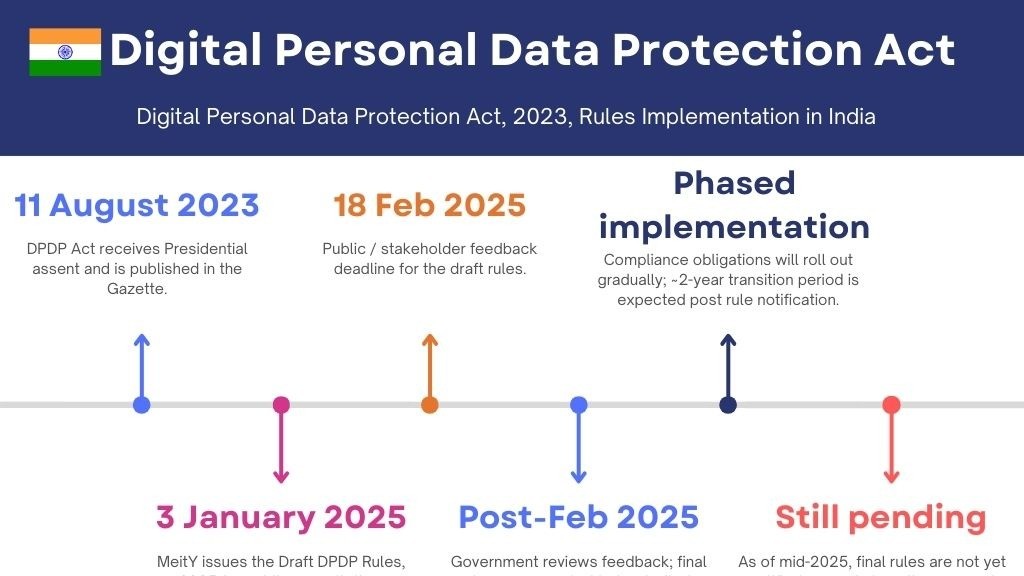
Image credit: DPDP Act timeline illustration showing India’s phased privacy law rollout
Other Important Frameworks {#others}
Don’t forget:
- Brazil’s LGPD
- China’s PIPL (strict on cross-border transfers)
- UK’s UK GDPR (post-Brexit but very similar to EU version)
- Canada’s PIPEDA updates and new provincial laws
- Sector-specific rules like HIPAA for health data or PCI-DSS for payments
The trend? More alignment on core principles, but local nuances remain. A solid global compliance program uses a “highest common denominator” approach.
The Ultimate 2026 Data Privacy Regulations Compliance Checklist
This is the heart of the post — a practical, step-by-step checklist that works across most data privacy regulations. Go through each item, document what you do, and review it quarterly.
Step 1: Map Your Data (Data Inventory and Flow Mapping) Start here. List every piece of personal data you collect, where it comes from, where it goes, how long you keep it, and why. Include customer data, employee data, website visitors, app users, and third-party sources.
Tools to help: Spreadsheets at first, then move to specialized software. Ask questions like:
- Do we really need date of birth for account creation?
- Who has access to this database?
This step alone satisfies requirements in GDPR, CCPA, DPDP, and almost every other law. Update the map whenever you add new tools or features.
Step 2: Determine Which Laws Apply to You Review your customer base, revenue, and data processing volume against each law’s thresholds. Use our free applicability checker template (download link on site).
Step 3: Appoint Responsible People
- Designate a privacy lead (can be part-time for small teams)
- Appoint a DPO where required (EU, certain Indian SDFs)
- Train everyone who touches data
Step 4: Update Your Privacy Policy and Notices Make it clear, layered (short version + detailed), and easy to find. Include:
- What data you collect
- Purposes and legal basis
- Sharing details
- Individual rights
- Contact information
For CCPA 2026, add specific categories of data shared in the last 12 months. Post it on your homepage footer, in apps, and at data collection points.
Step 5: Build Proper Consent Mechanisms No more pre-ticked boxes or “by using our site you agree.” Consent must be granular where possible.
In 2026:
- Honor Global Privacy Control signals automatically
- Use cookie consent banners that are balanced (no dark patterns)
- For DPDP, record consent with timestamps and withdrawal options
Step 6: Secure the Data Implement technical and organizational measures:
- Encryption at rest and in transit
- Access controls (least privilege)
- Regular vulnerability scans
- Secure vendor contracts with Data Processing Agreements (DPAs)
CCPA now requires cybersecurity audits for bigger businesses — start building that habit.
Step 7: Enable Individual Rights Requests Create simple processes for:
- Access / Know
- Deletion / Erasure
- Correction
- Opt-out of sale or targeted advertising
- Portability (where required)
Respond within 30-45 days depending on the law. Track requests in a central log.
Step 8: Manage Third-Party Vendors Review every tool that processes data (analytics, email marketing, cloud storage, payment processors). Sign DPAs. Conduct due diligence. Include flow-down clauses.
Step 9: Prepare for Breaches Have an incident response plan ready:
- Who to notify internally
- How to assess risk
- Template letters to affected people and regulators
- Timeline (72 hours for GDPR, quicker for some U.S. states)
Test it with a tabletop exercise every year.
Step 10: Conduct Training and Awareness All employees, contractors, and even board members need basic privacy training. Make it annual and role-specific (marketing team gets extra on advertising rules).
Step 11: Perform Risk Assessments and Audits For high-risk activities (sensitive data, large-scale profiling, AI decisions), document risks and mitigations. CCPA and GDPR both require this in 2026.
Step 12: Document Everything Privacy is about accountability. Keep records of processing activities, consent proofs, training logs, and assessment reports.
Step 13: Monitor and Update Continuously Laws change. Your business changes. Set calendar reminders for annual reviews and subscribe to privacy newsletters.
Step 14: Handle Children’s Data Carefully Many laws (CCPA, GDPR, upcoming U.S. state rules) have extra protections for minors under 13 or 16. Get verifiable parental consent where needed.
Step 15: Plan for International Transfers If you move data outside the origin country, use Standard Contractual Clauses, adequacy decisions, or other safeguards. Document Transfer Impact Assessments.
Follow this checklist and you’ll be in great shape for 90% of situations. For the remaining 10%, consult a local privacy lawyer for your specific setup.

Image credit: IT Security and Privacy Checklist 2026 illustration – shows team working on compliance together
Industry-Specific Tips for Data Privacy Regulations Compliance {#industry-tips}
E-commerce: Focus on checkout data, cookies for retargeting, and international shipping addresses. Honor opt-outs for personalized ads immediately.
SaaS / Tech Companies: Pay extra attention to ADMT rules if your product uses AI recommendations or scoring. Document how algorithms work.
Healthcare: Layer HIPAA or equivalent on top of general privacy laws. Consent for health data is stricter.
Finance: PCI-DSS plus privacy rules. Customers expect high security.
Marketing Agencies: Client data is your responsibility too. Use data processing agreements and limit what you collect.
No matter your industry, the principles stay the same — just scale the effort.
Common Pitfalls and How to Avoid Them {#pitfalls}
- Dark patterns in consent — Don’t make “Accept All” big and green while “Reject” is tiny. Regulators are fining this heavily in 2026.
- Forgetting employee data — Privacy laws cover staff too.
- Outdated vendor contracts — Review them annually.
- Assuming one policy fits all — You may need region-specific notices.
- Poor breach response — Practice makes perfect. A slow or sloppy response multiplies damage.
Avoid these and you’ll sleep better at night.
Helpful Tools and Resources {#tools}
- Free: OneTrust Privacy Checklist templates, CookieYes for consent management
- Paid but worth it: Osano, TrustArc, BigID for data discovery
- Open source: Matomo for privacy-friendly analytics
- Browser tools: Global Privacy Control extensions
External resources worth bookmarking:
- California Privacy Protection Agency: https://cppa.ca.gov/
- European Data Protection Board: https://www.edpb.europa.eu/
- India’s MeitY DPDP page
Our site also offers free privacy policy generator updated for 2026 and compliance audit checklist download.
Real-World Case Studies
A mid-sized Indian e-commerce company we advised faced DPDP and CCPA requirements. They mapped data, updated their consent banner, and added deletion workflows. Result? Zero fines, 18% higher customer retention in the first quarter after launch, and positive media coverage about their privacy-first approach.
Another example: A U.S. SaaS firm hit with CCPA ADMT rules implemented pre-use notices for their recommendation engine. Customers loved the transparency and usage actually increased.
These stories show compliance pays off.
What the Future Holds for Data Privacy Regulations
2027 and beyond will likely bring more harmonization attempts, stronger AI rules, and possibly a U.S. federal law. Expect continued focus on children’s data, health data, and cross-border flows.
The winners will be companies that treat privacy as part of product design from day one — “privacy by design.”
Conclusion
Data privacy regulations in 2026 are complex, but they’re also your opportunity to build deeper trust and a more resilient business. Use this checklist, stay informed, and review regularly.
Start small today: Do your data inventory this week. You’ll feel the difference immediately.
If you need help implementing any part of this, drop a comment below or reach out — we’re here to help fellow business owners succeed in this privacy-first world.
Stay safe, stay compliant, and keep growing.
FAQ
Q1: Do small businesses need to worry about data privacy regulations in 2026? Yes, if you handle personal data of people in regulated areas. Many laws have low thresholds or apply based on targeting.
Q2: What’s the biggest change in CCPA for 2026? New requirements for risk assessments, cybersecurity audits, and automated decision-making transparency.
Q3: How does DPDP differ from GDPR? DPDP is more consent-focused and has phased implementation, while GDPR has broader lawful bases.
Q4: What is the penalty for non-compliance? It varies — GDPR up to 4% global turnover, DPDP up to ₹250 crore, CCPA civil penalties per violation plus private rights of action.
Q5: Do I need a lawyer for this? For basic compliance, the checklist above plus free resources often suffice. For complex setups, yes, consult one.
Q6: How often should I review my privacy practices? At least annually, plus whenever you launch new features or enter new markets.
Q7: What about AI tools we use? Check if they process personal data and apply ADMT or high-risk rules where required.
Q8: Can I use the same privacy policy everywhere? Often yes with clear sections for different regions, but sometimes separate notices work better.
Q9: Where can I find official checklists? See links to CPPA, EDPB, and MeitY above.
Q10: How do I prove compliance if audited? Documentation is king — keep records of everything you do.
Share this content:






Post Comment